For generations, the pathway for a talented young athlete looked relatively straightforward.
Perform well at school. Get selected for representative teams. Hope the right coach or scout notices you. Move into university, an academy or a professional environment. Build a career. Then, if you become successful enough, sponsorships and commercial opportunities might follow.
That sequence is beginning to change.
One of the biggest forces behind that change is Name, Image and Likeness — NIL.
NIL is often discussed as though it simply means athletes can earn money from sponsorships. That is part of it, but it misses the bigger story.
NIL is changing when an athlete’s commercial identity begins to matter. And that has consequences for young athletes, parents, schools, coaches, universities and the organisations responsible for helping athletes navigate their careers.
What exactly is NIL?
NIL refers to an athlete’s ability to receive compensation for the commercial use of their name, image or likeness.
The NCAA gives examples including paid social-media content, endorsements and sponsorships, appearances, autograph signings, camps and clinics. Importantly, legitimate NIL activity is not simply payment for playing sport. NCAA rules distinguish NIL compensation tied to genuine commercial activity from prohibited pay-for-play arrangements. NCAA.org
That distinction matters.
NIL essentially recognises something that has always existed: an athlete can have commercial value separate from the result they produce on Saturday afternoon.
Their story can have value.
Their audience can have value.
Their reputation can have value.
Their association with a community, school, sport or cause can have value.
And their digital identity can have value.
The United States has already crossed the Rubicon
The transformation of American college sport has moved far beyond athletes simply being permitted to sign the occasional sponsorship agreement.
Following the House settlement changes, Division I institutions participating in the new structure can provide significant direct financial benefits to athletes. The NCAA describes the current environment as one in which Division I schools can direct approximately $20 million annually in financial benefits to student-athletes, alongside scholarships and other benefits. NCAA.org
Third-party NIL opportunities continue alongside that system.
And there is another development particularly relevant to young South African athletes considering the United States.
NCAA rules now specifically contemplate NIL agreements made by high-school prospects before they enter college. Prospective Division I athletes are required to disclose qualifying third-party NIL agreements of $600 or more dating from the relevant reporting period, and prospective athletes are permitted to discuss, negotiate and enter commercial NIL contracts before enrolling at a Division I institution. NCAA.org
Think about what that means.
The commercial conversation around an athlete no longer necessarily starts when the athlete becomes a college star.
It can begin before the athlete arrives on campus.
NIL is already reaching school sport
This is where the conversation becomes particularly interesting for South Africa.
High-school NIL in the United States is not governed by one simple nationwide rule. State associations have developed different approaches and restrictions. The National Federation of State High School Associations reported that dozens of state associations had introduced NIL policies, while stressing that education-based sport must retain appropriate safeguards. NFHS
So this should not be interpreted as “every American school athlete can now make money however they want.”
They cannot.
But the direction of travel is significant.
The line separating school athlete, college athlete and commercially valuable athlete is becoming less distinct.
And that could eventually have consequences far beyond America.
South Africa is different – but that doesn’t mean we should ignore what is happening
South Africa should not simply copy the American college sports model.
Our sporting structures, schools, universities, governing bodies and commercial environment are different.
But South Africa has something that makes the NIL conversation particularly important:
school sport is already enormously important to our sporting culture.
Government itself increasingly describes school sport as a pathway. The Western Cape’s 2026 School Sport Strategy, backed by R130 million over three years, explicitly focuses on developing pathways from participation towards provincial, national and international competition. Western Cape Government
National school championships are also explicitly used for talent identification and athlete development. Department of Education
And school sport now has substantial digital reach. The South African government highlighted the SuperSport/SABC school-sport partnership as a mechanism for increasing athlete visibility and noted that SuperSport Schools had already passed one million registered users. Government of South Africa
That creates an interesting question.
What happens when increasingly visible school athletes begin developing commercially valuable identities before they leave school?
South Africa does not need to have an American-style NIL system for that question to become relevant.
The audience is already being built.
The content is already being distributed.
The athletes are already becoming recognisable.
Commercialisation is therefore a conversation South African sport needs to understand before it simply arrives.
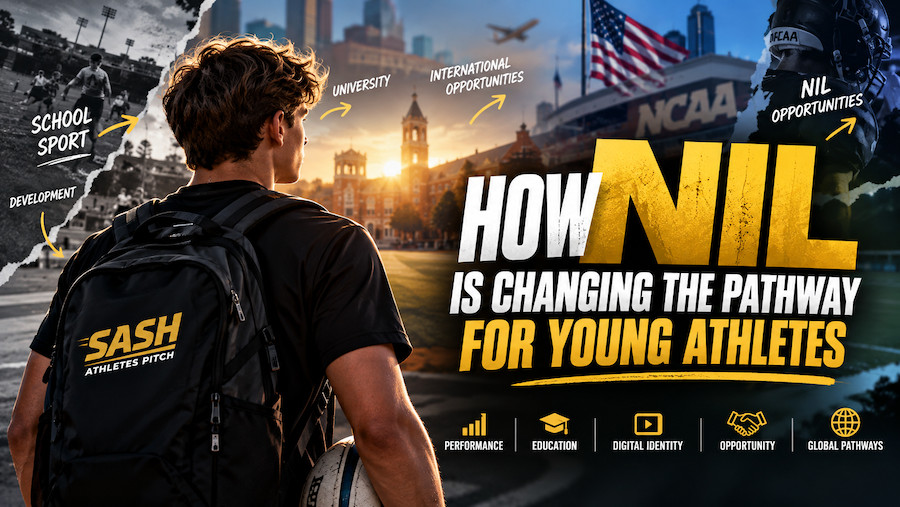
The traditional pathway was linear. The new pathway isn’t.
Previously, we tended to think about athlete development roughly like this:
School → University/Academy → Professional Sport → Commercial Opportunities
NIL potentially changes that to something much more interconnected:
Performance + Education + Digital Identity + Visibility + Reputation + Audience + Commercial Literacy → Opportunity
And that creates both opportunity and risk.
A 16-year-old athlete may now need to think about things previous generations only encountered after becoming professional: personal branding, social-media behaviour, contracts, commercial rights, reputation, financial literacy and the permanence of their digital footprint.
That does not mean teenagers should become influencers.
In fact, that is precisely the trap we should avoid.
Your digital athlete identity is bigger than your social-media following
A young athlete could easily misunderstand NIL and conclude:
“I need more Instagram followers.”
That would be an extremely shallow interpretation of what is happening.
A serious athlete’s digital identity should begin with credibility, not popularity.
What sport do you play?
Where do you compete?
What are your verified results?
How have your performances progressed?
What level are you competing at?
What video supports those performances?
What is your sporting history?
What are your educational ambitions?
What kind of person and athlete are you becoming?
These questions matter whether an athlete ever earns one rand through NIL.
They matter because sport itself is becoming increasingly digital and data-driven.
This philosophy sits at the centre of Athletes Pitch. The platform is deliberately positioned as a structured athlete visibility platform rather than social media or a recruitment guarantee, with verified performance, measurable progression and ethical athlete development at its core. Athletes Pitch Marketing Playbo…
This is why we built Athletes Pitch
Athletes Pitch was not created to turn teenagers into commercial products.
It was created because too many talented athletes remain invisible simply because they do not have access to the right networks, schools, agents or people.
Our philosophy is simple:
Build the sporting record first.
An Athletes Pitch profile is intended to become a structured sporting CV – a place where performance, video, history and progression can develop over time. Our own framework deliberately prioritises performance context over viral clips and treats the athlete profile as something that becomes more valuable as the athlete’s journey develops.
That becomes even more relevant in an NIL world.
Because before an athlete worries about monetising their identity, they should first build a credible identity.
And before commercial opportunity comes education.
Why our relationship with Darin Hickman matters
This changing landscape is also one of the reasons Athletes Pitch is developing relationships that help us understand what is happening internationally rather than pretending the South African sporting environment exists in isolation.
Through our partnership with Darin Hickman and Tau Sports Bridge, we are developing a stronger understanding of the American student-athlete environment and the realities young athletes need to understand when exploring opportunities in the United States.
That includes much more than simply asking:
“Can I get a scholarship?”
Athletes increasingly need to understand eligibility, academics, recruitment, personal development, digital identity and the rapidly changing NIL environment.
There is also an important caution here for international athletes. American NIL rules and U.S. immigration rules are separate issues. An NIL opportunity that may be permissible under sporting regulations does not automatically mean an international student can undertake the activity under their immigration status. Athletes considering the U.S. therefore need qualified guidance rather than assumptions based on what American athletes are doing.
That complexity is exactly why education must come before opportunity.
And why Coach Loffie Eloff’s voice matters
Technology and international pathways are only part of athlete development.
The other part is something sport has understood for generations: good coaches matter.
Coach Eugene “Loffie” Eloff brings extensive experience in coaching, athlete development and international pathways to the wider SA Sports HUB and Athletes Pitch ecosystem. Our partnership material specifically positions him as a strategic sports advisor bringing experience in athlete development, coaching and international pathways.
That perspective becomes increasingly valuable in an NIL environment.
Because the objective cannot become:
“How quickly can we monetise a talented 16-year-old?”
The better question is:
“How do we develop the athlete, the student and the person so that they are ready when opportunities arrive?”
That distinction matters enormously.
The athlete of the future will need more than talent
None of this diminishes sporting performance.
You still have to run the time.
Score the runs.
Make the tackles.
Win the points.
Put in the training.
NIL does not replace performance.
But performance may increasingly exist inside a much larger ecosystem.
The successful athlete of the future may need to understand performance, education, data, digital identity, communication, personal brand, contracts, commercial rights and long-term career planning.
And that education should start before somebody offers them money.
The opportunity for South Africa
Perhaps the biggest lesson from America is not that South Africa should rush towards NIL.
It is that we have an opportunity to prepare.
Schools can educate athletes.
Parents can learn how the landscape is changing.
Coaches can remain central to athlete development.
Sporting organisations can develop appropriate safeguards.
Brands can learn to work responsibly with young athletes.
And athletes can begin building credible sporting records long before they need them.
That is the role we believe Athletes Pitch can play.
Not an agent.
Not a scholarship broker.
Not a promise that somebody will be recruited.
Athletes Pitch is building a structured athlete visibility ecosystem designed to help serious athletes document their performance, build credible sporting profiles and become visible to legitimate sporting organisations while protecting the integrity of the athlete journey. That positioning is deliberately built around visibility rather than guaranteed recruitment or scholarships.
Because the pathway is changing.
NIL is only one part of that change.
But it is revealing something much bigger:
A young athlete’s sporting journey is no longer happening only on the field. Their performance, data, education, reputation and digital identity are increasingly becoming part of the same story.
The athletes who understand that early won’t necessarily be the athletes with the most followers.
They’ll be the athletes who are best prepared.
And that is exactly where we believe the future of athlete development begins.